English Tech Video -> Chinese Localized Dub
TikTok @huwprosser
Local-first video localization system
VoxVid is not a subtitle translator. It is a local-first dubbing production system with vocal separation, speaker routing, script adaptation, fixed voices or voice cloning, timing alignment, quality analysis, and visual review in one workflow.
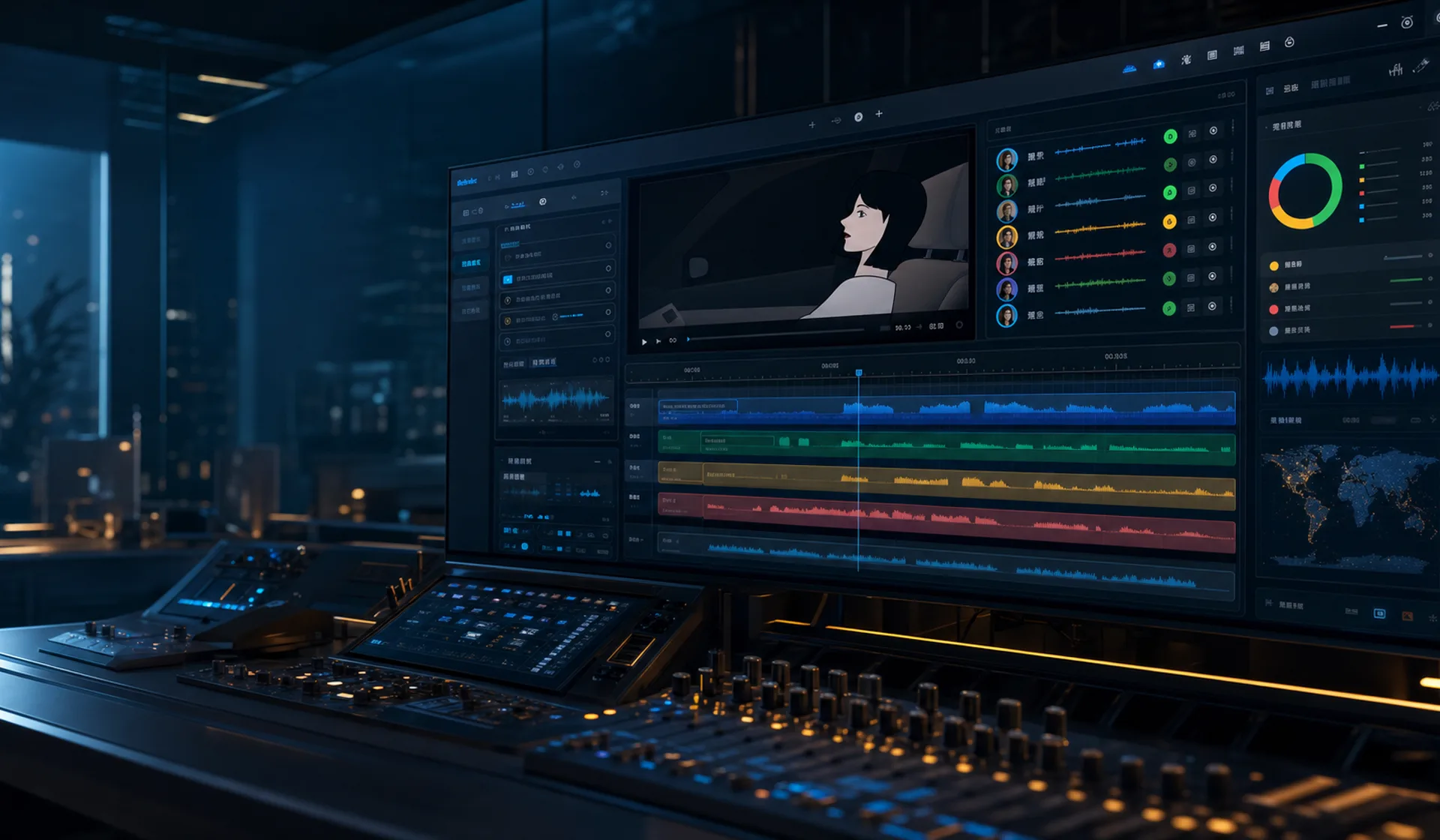
Showcase
The page loads only covers by default. Videos are requested only after a click, reducing bandwidth and landing-page cost.
Example sources are credited. VoxVid versions are used to demonstrate localization capability.
TikTok @huwprosser
抖音「全能查」
Core system
Separate source speech from music and SFX, preserve atmosphere, and replace only the original voice.
Map narrator, male/female roles, dialogue turns, and reusable voices to reduce speaker mismatch.
Fit new speech to source timing with role speed, slot length, and tail-safety checks.
Support literal translation, conversational rewrite, target-market adaptation, and creator-style rework.
Flag long lines, empty slots, overlaps, tail cuts, background bleed, and voice risks before export.
Keep common models, voices, assets, and stage caches locally to reduce repeated cloud cost.
Local economics
Traditional SaaS tools often charge per minute, task, or generation. VoxVid moves the heavy stages onto your local GPU, workstation, or private network so assets, models, and stage caches keep paying back over time.
Rent platform compute
Useful for quick starts, but longer videos, bigger batches, and failed reruns usually make the bill and the uncertainty climb together.
Own the production line
Closer to reusable production infrastructure: local compute runs the core stages while caches, voice libraries, and workflows compound in value.
Production cost breakdown
Billing model
Asset handling
Voice and model control
Long-form and batch work
Failed reruns
Workflow surface
The showcase starts with English-Chinese directions, while the system is designed for multi-language localization projects.
Workflow
Visual console
The web console is also deployed on the client's local machine, workstation, or private network. It gives teams a visual way to review preview, speaker recognition, quality status, script lines, and live color risks while the local backend handles the pipeline.
Open console page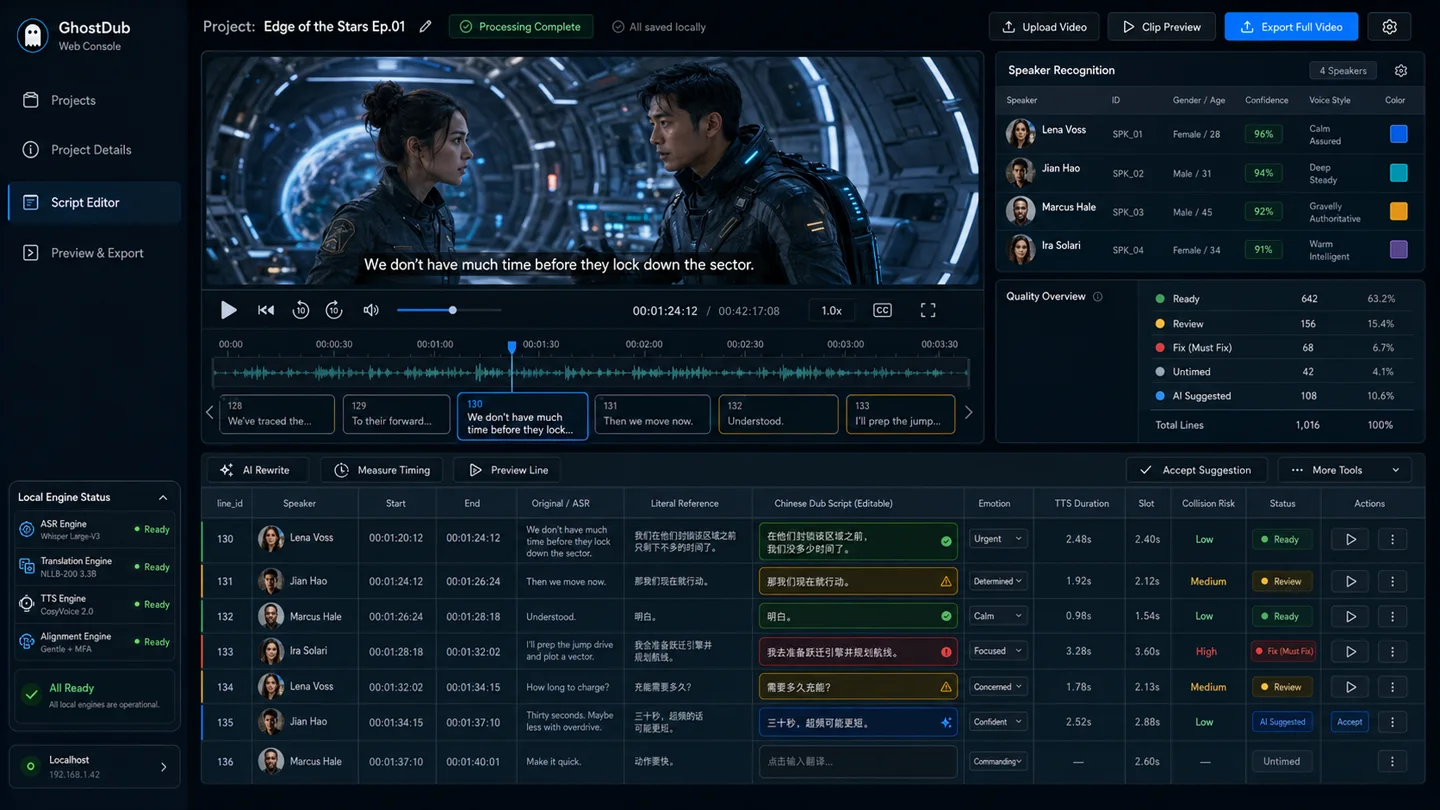
Click to open the full console demo
The home page shows a lightweight preview. Full script table and quality report live on the console page.
Use cases
Turn overseas AI tools, SaaS walkthroughs, and software demos into localized shorts for new markets.
Turn Chinese product explanations, order tools, and service flows into English videos for TikTok, YouTube Shorts, and landing pages.

Preserve rhythm and background sound while adapting educational, story, and talking-head clips for another audience.
Customer outcomes
These examples describe common delivery scenarios and business goals. Actual results depend on source material and distribution.
Reviews

Cross-border content lead
★★★★★
“The quality report matters most. We do not wait until export to discover that a line is too long or a role voice is wrong.”

AI tool creator
★★★★★
“One video can quickly become Chinese and English versions while keeping the original music. Publishing is much faster.”

Studio owner
★★★★★
“The agent workflow handles batch automation, while the web console gives editors and clients a clear review surface. It made our delivery process much easier to explain.”
Pricing
Trials start at $99. Complete systems can include agent workflows, visual review consoles, and local deployment for Mac, Windows, and Linux.
View full pricing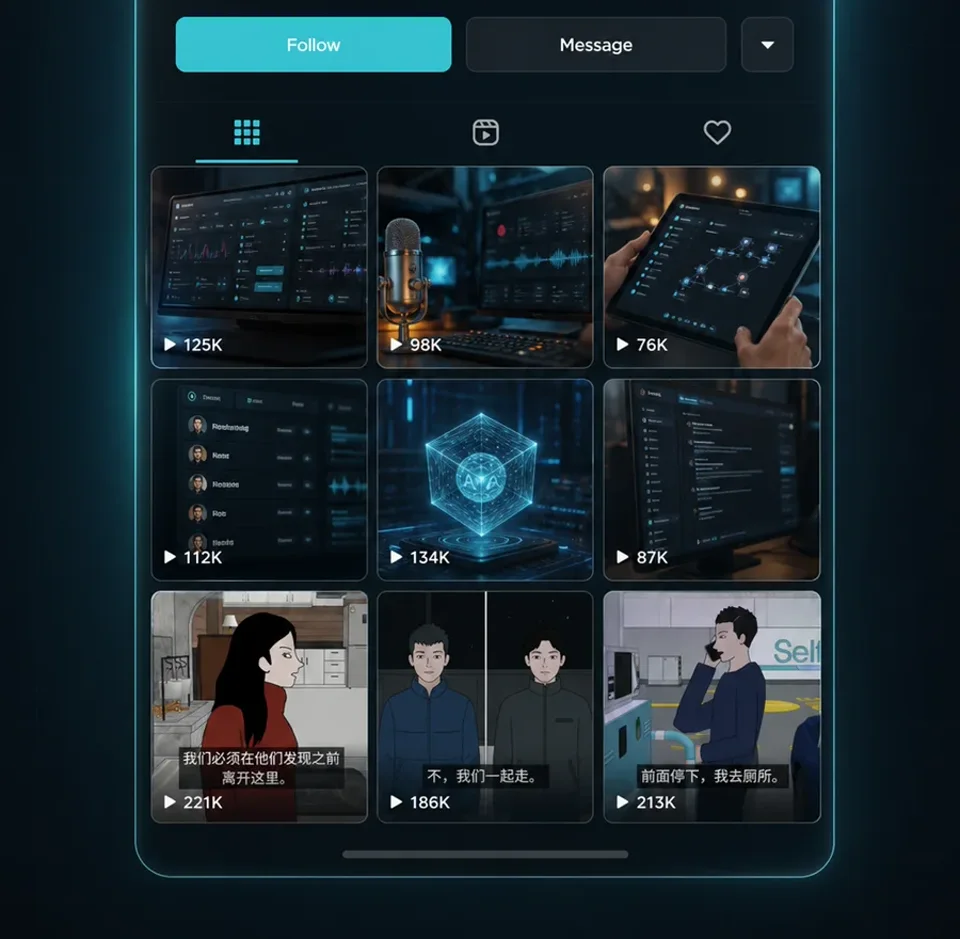
FAQ
No. Core production can run around local machines and local models. Cloud services are optional for hosting, delivery, or selected APIs.
No. Chinese-English directions are current demos; the system architecture can expand to more languages depending on model and review setup.
Deployment can be planned for Mac, Windows, and Linux depending on GPU, model cache, and batch processing needs.
Pick a package, book a trial, send a video or link, and describe the target language and voice style. We will generate a localized sample for you for free so you can evaluate the actual lip-sync and translation quality before deployment.
Yes. Each project can choose literal translation, conversational localization, market adaptation, or creative rewrite while keeping a literal reference.
Yes. VoxVid can use fixed voices or cloned voices. For commercial delivery, clean reference audio is preferred to avoid noise and background bleed.
Agent delivery lets Codex, OpenClaw, Claude Code, or similar agents drive the local tools through chat. Web delivery installs a local or private-network visual panel for content teams to review, edit lines, and approve output. They can also work together.
Yes. Project delivery can connect to CLI, MCP, queues, cloud storage, fixed folders, and existing agent workflows.
No. Audio and video processing itself does not consume agent tokens. The heavy stages such as transcription, separation, TTS, alignment, and mixing run on local machines or the models you choose. Agent tokens are mainly used for chat, orchestration, and small text rewrites, so they are usually a tiny share of total cost. Extra costs only appear if you choose third-party cloud APIs, cloud storage, or paid model services.
Contact
Available for sample clips, script workflows, local deployment, agent orchestration, web review consoles, and private systems.